

European Commission publishes a new version of the Digital Competences Framework
On 11 November 2025, the European Commission’s Joint Research Centre published the fifth iteration of the Digital Competence Framework (DigComp 3.0). DigComp describes what is needed to be digitally competent in today’s society. It supports the development of digital competence among individuals of all ages. The framework covers a wide range of digital skills levels, from basic to highly advanced.
DigComp 3.0 (2025) is the fifth iteration of the framework. The first version was published in 2013, with updates published in 2016, 2017 and 2022.
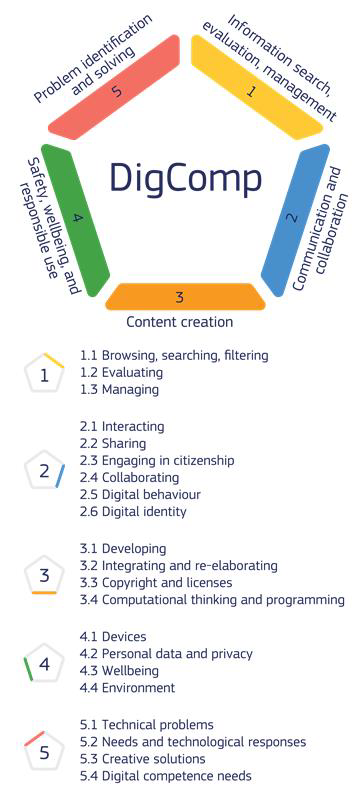
The DigComp 3.0 update prioritises Artificial Intelligence (AI) competence, cybersecurity competence, digital rights, choice and responsibilities, wellbeing in digital environments, and competences to tackle mis- and disinformation. These priorities were identified by looking at recent research and policies, and consulting with experts and stakeholders.
Consistent with previous iterations, DigComp 3.0 describes five competence areas. Under each competence area, there are between three and six competences – 21 competences in all (see image). Each competence area and competence is described in detail in the full DigComp 3.0 framework.
For each competence, DigComp 3.0 has four proficiency levels (Basic, Intermediate, Advanced and Highly Advanced levels), describing progression in individuals’ capacities to complete tasks in digital environments. As proficiency progresses, individuals can act more autonomously, and understand and complete tasks that are increasingly complex and cognitively demanding. The level of digital competence that a person needs varies from individual to individual and can change over time.
The DigComp 3.0 update maintains continuity with the previous version, DigComp 2.2, while incorporating changes that reflect developments in digital technological trends and practices since 2022:
- Updates to the wording of competence areas and competences
- Revised proficiency levels
- New learning outcomes (short statements of what an individual knows or is able to do after completing a learning process of any kind).
- A transversal integration of AI competence
- An extended Glossary that explains the words and terms used
- Multiple formats, for easier tailoring and adaptation of the framework.
You can find more information on DigComp 3.0 available here.
-
EQUASS
The European Quality in Social Services (EQUASS) is an initiative of the European Platform for Rehabilitation (EPR). EQUASS enhances the social sector by engaging social service providers in continuous improvement, learning and development, in order to guarantee service users quality of services throughout Europe.

-
 This website received support from the European Union’s Citizens, Equality, Rights and Values (CERV) programme. For further information please click here.
European Platform for Rehabilitation – Avenue des Arts, 8 – 1210 Brussels – Belgium
Tel. +32 2 736 54 44 – mail: epr@epr.eu
Co-funded by the European Union. Views and opinions expressed are however those of the author(s) only and do not necessarily reflect those of the European Union or the granting authority. Neither the European Union nor the granting authority can be held responsible for them.
Copyright © 2017 - 2026 | Privacy Policy | Cookie Policy ALYS