

Insights from the InDiCo Pilot Phase: Testing a Digital Tool for Learners from Mariaberg (Germany)
Author: Lea Busche, Social Education Worker, Mariaberger Ausbildung & Service gGmbH
When we first developed the InDiCo project catalogue of relevant basic digital competences for persons with learning difficulties, it quickly became clear: this tool is not meant to measure “Can I or can’t I?” but rather to enable self- and peer-assessments. Implementing it with the learners, however, brought new challenges and offered fascinating insights into their digital competencies and how they perceive learning.
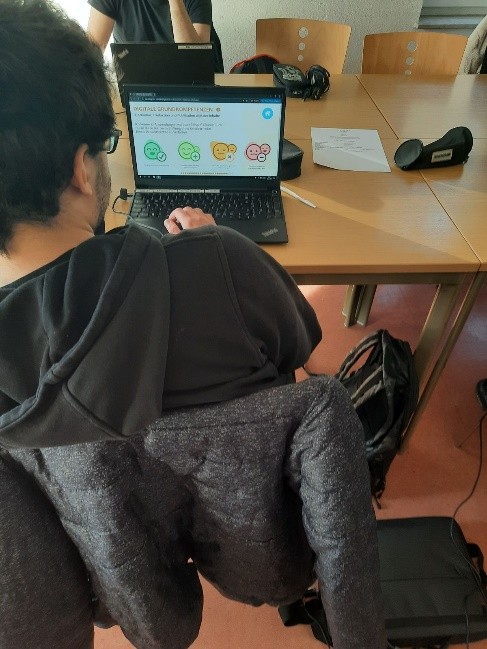
At Mariaberg, we selected seven learners for the pilot: six from a pre-vocational training program (BvB) and one apprentice with a rehabilitation status. We asked ourselves whether our current BvB participants were suitable for the target group at all and whether piloting the tool in a group setting would make sense. For both reasons, we additionally included the rehabilitation apprentice, who fits the target group well and allowed the test to be conducted in a one-on-one setting.
One of the most insightful aspects was how the pilot created shared learning moments. After the learners completed the self-assessment, we went through specific topics together. It became clear how differently learners evaluate their own competencies and which skills become visible only through discussion. Some appeared skeptical or bored at first; the purpose of the exercise was not immediately obvious. Yet in these moments, we were able to better recognise their strengths and potential for development.
The questions in the competency catalog were deliberately designed to reflect behavior and applied competence, for example, “I do …” or “I give examples …”. As a social pedagogue, I asked myself: how can I carry out a peer assessment without simply labeling skills as “can/can’t”? This reflection also highlighted an important societal point: in our society, almost everything is judged by whether someone “can” or “cannot” do something. For people with learning difficulties, this can be very stressful, as quick judgments are often made without taking the time to look more closely, provide support, or consider individual circumstances. The InDiCo tool offers a way to reduce this pressure and observe learners’ development in a more nuanced way.
Currently, we are in the evaluation phase: my colleague and I are conducting the peer assessments. I am curious about the results – where do self- and peer-assessments align, where do they differ? What conclusions can we draw for further developing digital competencies?
What this pilot has shown me most clearly is that digital competence is more than “can/can’t.” It involves self-awareness, reflection, and individualised support. Through the tool, not only do we gain new insights into learners’ abilities but can also define targeted developmental goals – a crucial step in better supporting people with learning difficulties.
The InDiCo – Increase Digital Competences to Promote Inclusion project aims to reduce the digital gap and promote the social inclusion of people with learning difficulties.
-
EQUASS
The European Quality in Social Services (EQUASS) is an initiative of the European Platform for Rehabilitation (EPR). EQUASS enhances the social sector by engaging social service providers in continuous improvement, learning and development, in order to guarantee service users quality of services throughout Europe.

-
 This website received support from the European Union’s Citizens, Equality, Rights and Values (CERV) programme. For further information please click here.
European Platform for Rehabilitation – Avenue des Arts, 8 – 1210 Brussels – Belgium
Tel. +32 2 736 54 44 – mail: epr@epr.eu
Co-funded by the European Union. Views and opinions expressed are however those of the author(s) only and do not necessarily reflect those of the European Union or the granting authority. Neither the European Union nor the granting authority can be held responsible for them.
Copyright © 2017 - 2026 | Privacy Policy | Cookie Policy ALYS